UK SRS S2 · Climate disclosures
UK SRS S2: climate-related disclosures
UK SRS S2 is the UK’s climate-related disclosure standard — the UK endorsement of the ISSB’s IFRS S2, published by the Department for Business and Trade on 25 February 2026.
It is a voluntary standard. The FCA’s final rules require listed companies in scope to report against it on a comply-or-explain basis from 1 January 2027, finalising FCA CP26/5.
Status
Voluntary now, comply or explain from 2027
No UK entity is required by law to report against UK SRS S2 today.
Any UK entity may adopt it voluntarily, and has been able to since 25 February 2026.
For listed companies, the FCA’s final rules (PS26/19, 30 September 2026) require companies in scope to report against UK SRS on a comply-or-explain basis for accounting periods beginning on or after 1 January 2027.
They finalise FCA CP26/5, published on 30 January 2026 and closed on 20 March 2026, which had proposed making UK SRS S2 mandatory; the final rules do not.
CP26/5 estimated that around 600 listed companies would be affected; the Policy Statement gives no total count.
UK SRS S2 goes further than the existing TCFD-aligned listing rule disclosures, with quantified financial effects, required scenario analysis and value chain emissions reporting.
The clause-by-clause reference for UK SRS S2 is maintained on our primary reference site — the place to start if you want the standard itself rather than the delivery view.
Where the obligation comes from
- 25 Feb 2026UK SRS S1 and S2 published
Department for Business and Trade. Available for voluntary use by any UK entity.
- 30 Jan 2026FCA CP26/5 published
Proposed mandatory UK SRS S2 for in-scope listed companies. Consultation closed 20 March 2026.
- 30 Sep 2026FCA final rules — PS26/19
Comply or explain across the UK SRS, S2 included. The mandatory proposal was not adopted.
- 1 Jan 2027Rules apply
For accounting periods starting on or after this date.
- 2028First reports
First reporting under the final rules.
What it is
What is UK SRS S2?
UK SRS S2 requires an entity to disclose the climate-related physical risks, transition risks and opportunities that could reasonably be expected to affect its cash flows, its access to finance, or its cost of capital.
It must be applied together with UK SRS S1, which sets the general requirements — materiality, reporting boundary, and the “Connected information” requirement with the financial statements — that UK SRS S2 then applies to climate.
For how the two standards fit together, see UK SRS S1 and S2, or our own delivery view of UK SRS S1 and S2 together.
Requirements
UK SRS S2 requirements: the four pillars
UK SRS S2 keeps the four-pillar structure inherited from TCFD — governance, strategy, risk management, and metrics and targets.
What changed is what sits inside each pillar.
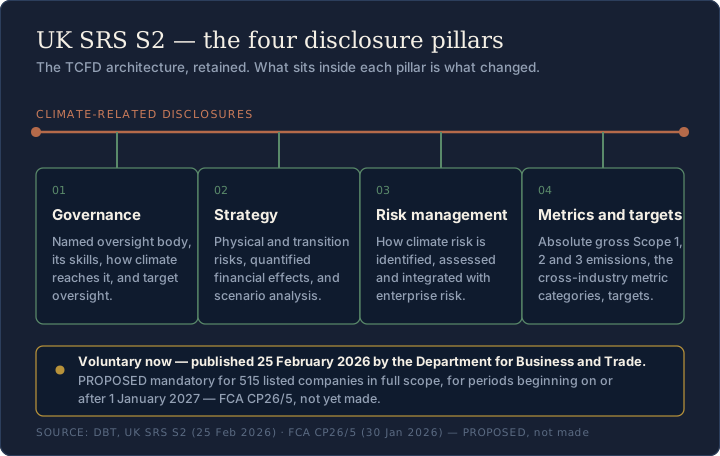
The key upgrade over TCFD is required quantification of current and anticipated financial effects, with qualitative disclosure permitted only where the Standard’s conditions for it are met.
The four-pillar architecture is covered in more depth at the UK SRS four pillars.
TCFD to UK SRS S2 Transition
Interactive comparison of requirements across the four-pillar framework
Board oversight (voluntary)
Principles-based recommendations for board oversight of climate-related risks and opportunities
Voluntary principlesRequirements
- Describe board oversight of climate risks/opportunities
- Describe management's role in assessing climate risks/opportunities
- General governance arrangements disclosure
Prescribed governance disclosures
Detailed requirements for governance body identification, skills assessment, and decision-making processes — the whole governance requirement sits in UK SRS S2 paragraph 6
Prescribed and detailedRequirements
- Identity and responsibility of oversight body (S2 para 6(a))
- Skills and competencies assessment (S2 para 6(a)(ii))
- Information flow and reporting processes (S2 para 6(a)(iii))
- Strategic integration and trade-offs (S2 para 6(a)(iv))
- Target oversight and performance monitoring (S2 para 6(a)(v))
- Management's role in governance (S2 para 6(b))
Strategy
Climate resilience and scenario analysis
Unlike the TCFD recommendations, UK SRS S2 makes climate scenario analysis a requirement rather than an expectation.
An entity must test its strategy and business model against climate-related scenarios, with the sophistication of the analysis commensurate with its exposure to climate-related risk.
Scenario analysis requirements are covered in detail at climate scenario analysis under UK SRS.
A company with significant climate exposure would find a purely qualitative narrative hard to justify.
Quantified analysis with explicit, disclosed assumptions is the expectation that follows from the Standard’s proportionality test.
Metrics
Scope 1, 2 and 3 emissions
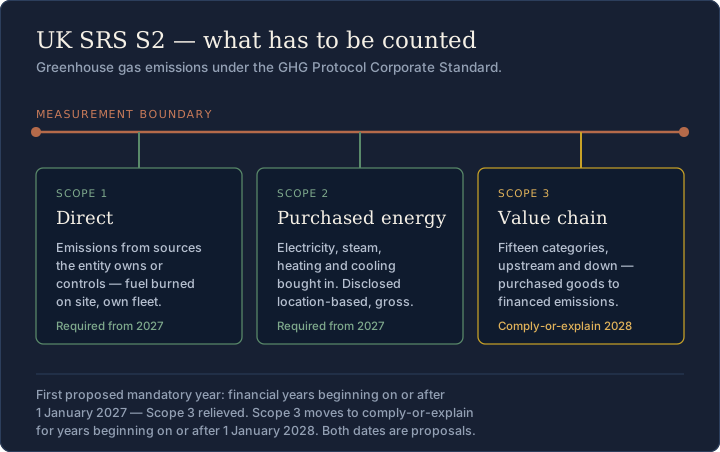
UK SRS S2 requires absolute gross greenhouse gas emissions across all three scopes, measured in accordance with the GHG Protocol Corporate Standard.
See how the calculation is actually done in practice for the full methodology, including the DESNZ 2026 conversion factors.
What the FCA’s final rules say about Scope 3
Under the final rules every UK SRS disclosure, Scope 3 included, is comply or explain.
A company may use a one-year relief from disclosing Scope 3; it states that it is using the relief, and no further explanation is required during the relief period.
After that year, a company either discloses Scope 3 or explains why it has not.
The consultation, CP26/5, had already put Scope 3 on comply-or-explain while proposing the rest of UK SRS S2 as mandatory; the final rules extend comply-or-explain to all of it.
See Scope 3 under UK SRS for the fifteen GHG Protocol Scope 3 categories and the data work each one implies.
Metrics
Cross-industry metrics, targets and financed emissions
| Metric category | What UK SRS S2 asks for |
|---|---|
| Transition risk | Assets or business activities vulnerable to transition risk |
| Physical risk | Assets or business activities vulnerable to physical risk |
| Opportunities | Assets or business activities aligned with climate-related opportunities |
| Capital deployment | Capital deployed towards climate-related risks and opportunities |
| Internal carbon price | Whether and how a carbon price is applied in decision-making |
| Remuneration | How climate-related considerations are factored into executive remuneration |
Industry-based metrics may also be considered: the UK amendment softens the SASB reference from “shall refer to and consider” to “may refer to and consider”.
Where an entity has set climate-related targets, UK SRS S2 requires disclosure of the metric used, the objective, the base year and the period covered, and how the target is monitored.
UK SRS S2 for financial institutions
Banks, asset managers and insurers face the most extensive UK SRS S2 requirements through financed emissions disclosure, broken down by industry and by asset class.
One change bears on this cohort, though it is not a UK-specific amendment: the ISSB itself removed the requirement to use the Global Industry Classification Standard in its December 2025 amendment to IFRS S2, so any internationally recognised industry classification system may be used for financed emissions.
Sector-specific detail is at UK SRS for financial services.
Transition plans and assurance
Two things UK SRS S2 does not require
Transition plans
UK SRS S2 does not require an entity to have a climate-related transition plan, or to set climate targets aligned with any particular goal.
Where an entity does have a transition plan, the standard requires disclosure of specific information about it, including the key assumptions used in developing the plan and the dependencies on which it relies.
Under the FCA’s final rules, in-scope listed issuers disclose in the annual report whether they have a climate-related transition plan and, if so, where it can be found — but are not required to have one, as FCA CP26/5 had also proposed.
The wider question sits with the Government: DESNZ consulted on implementation routes from 25 June to 17 September 2025, and as at 26 September 2026 the GOV.UK page still shows no outcome.
See transition plans under UK SRS.
Assurance
Where an in-scope company obtains assurance over its UK SRS disclosures, it names the provider, which disclosures were assured and which assurance standards were used.
Assurance itself is not required.
ISSA (UK) 5000, issued by the FRC on 12 November 2025 and effective for engagements on periods beginning on or after 15 December 2026 (or as at a specific date on or after it, with earlier application permitted), is for voluntary use — it governs how an assurance engagement is performed, not whether one must be commissioned.
See UK SRS assurance.
Not required. If an entity has one, it discloses the key assumptions and dependencies.
Not required. Under the FCA’s final rules, a company that obtains it says who provided it and over what.
Differences
How UK SRS S2 differs from IFRS S2
The UK government consulted on six proposed amendments in June 2025, but two did not survive to publication and further provisions were added afterwards. The authoritative list of final differences is Annex A of the government’s consultation response, which carries no headline count.
| Difference | What changed |
|---|---|
| No fixed effective date | The effective-date clauses were removed; any application is set by separate UK regulation — for listed companies, the FCA’s listing rules (comply or explain, from 2027); for anyone else, nothing yet. |
| Delayed reporting relief removed | The IFRS S1 relief allowing sustainability information to be published later than the financial statements in the first year was withdrawn. |
| Climate-first relief untimed | Retained, but its fixed one-year period was removed from the Standard; the FCA's final rules give listed companies two years' non-disclosure of non-climate matters. |
| SASB reference softened | Industry-based metrics: "may refer to and consider" rather than "shall". |
| Statements when using reliefs | Added paragraphs clarify how an entity states compliance when using the reliefs. |
| Not a UK amendment: industry classification | GICS was removed by the ISSB's own December 2025 amendment to IFRS S2; the UK's own proposal was withdrawn once the ISSB acted. |
None of these changes what UK SRS S2 asks for in substance; they change when it applies and how far the ISSB’s industry guidance binds.
New or amended ISSB standards do not apply in the UK automatically — each must pass the endorsement process set out in the UK SRS framework and terms of reference, with the final decision taken by the Secretary of State.
The baseline is IFRS S2; the IFRS Foundation records UK progress in its UK jurisdictional snapshot.
Side-by-side detail, including IFRS S2 paragraph 6 on governance, is at UK SRS vs IFRS S1 and S2.
From TCFD
UK SRS S2 vs TCFD: what actually changes
A company already reporting against the FCA’s TCFD-aligned listing rules is partway to UK SRS S2, not starting from zero.
The four things that change are required quantification of financial effects, the “Connected information” requirement with the financial statements, required scenario analysis, and Scope 3 reporting.
TCFD itself was created by the Financial Stability Board and disbanded in 2023, with its monitoring responsibilities transferred to the IFRS Foundation.
See TCFD vs UK SRS.
The four upgrades
- 01Quantified financial effects
- 02Connected information with the financial statements
- 03Required scenario analysis
- 04Scope 3 reporting
Scope
Who reports under UK SRS S2, and when
Voluntary now. Any UK entity may adopt UK SRS S2, and has been able to since 25 February 2026.
Comply or explain from 2027. Under the FCA’s final rules, companies listed under UKLR 6, 14, 15, 16 and 22 report against UK SRS S2, or explain why not, for accounting periods starting on or after 1 January 2027 — including secondary listings and depositary receipts, for which CP26/5 had proposed only a signposting statement.
Closed-ended investment funds, open-ended investment companies, shell companies, and debt, securitised derivative and miscellaneous securities are excluded.
Private companies: undetermined. The Modernising corporate reporting consultation, published 7 September 2026 and closing 30 November 2026, says only that the government “will consider how UK SRS should be reflected in the Companies Act 2006”.
No government document proposes any threshold or date for private companies.
See who must comply with UK SRS, our UK SRS timeline, and the editorial UK SRS timeline on our sister publication.
Transitional reliefs
First-year reliefs in the standard itself include no comparative information and alternative GHG measurement methods.
Separately, the FCA’s final rules give two transitional reliefs a company may use: non-disclosure of Scope 3 for one year, and non-disclosure of UK SRS S1 non-climate matters for two years.
A company using a relief must state that it is doing so, and no further explanation is required during the relief period.
After the relief period, the matters it covered are reported, or their omission explained, on the same comply-or-explain basis.
Delivery
The four hardest areas
Four areas consistently prove the most resource-intensive.
Scope 3 emissions data
Supplier engagement usually has to run for more than one reporting cycle before full Scope 3 disclosure is achievable. The FCA’s one-year Scope 3 relief gives breathing space, but the data infrastructure work does not compress.
Scenario analysis with quantified effects
For a company with significant climate exposure, that means quantified analysis with explicit, disclosed assumptions rather than a narrative.
Connected information
Removing the delayed reporting relief means climate disclosures and accounts are published together, for the same period, on the same boundary — so sustainability and finance must share data and assumptions.
Financed emissions
Industry classification choices and methodology selection materially affect the figures disclosed.
Implementation priorities
- Listed companies: map existing TCFD disclosures to UK SRS S2, build Scope 3 data infrastructure, upgrade scenario analysis, and establish a team spanning sustainability, finance and risk.
- Financial institutions: design the financed emissions methodology and the data systems behind it, and decide the industry classification early.
- Private companies: monitor the Modernising corporate reporting consultation (closes 30 November 2026) and consider voluntary adoption.
Start with a structured gap assessment — see UK SRS gap analysis.
For the compliance pathway, see the UK SRS compliance guide and UK SRS reporting guidance.
Frequently asked
UK SRS S2 — frequently asked
What is UK SRS S2?
UK SRS S2 is the UK's climate-related disclosure standard, published by the Department for Business and Trade on 25 February 2026. It is the UK endorsement of the ISSB's IFRS S2, with UK-specific amendments. It requires an entity to disclose the climate-related risks and opportunities that could reasonably be expected to affect its cash flows, its access to finance or its cost of capital.
Is UK SRS S2 mandatory?
No. UK SRS S2 is a voluntary standard, and the FCA's final rules (PS26/19, 30 September 2026) do not make it mandatory: listed companies in scope report against it on a comply-or-explain basis for accounting periods beginning on or after 1 January 2027, with first reporting in 2028. The consultation, CP26/5, had proposed making UK SRS S2 mandatory for those companies, excluding Scope 3; the final rules adopt comply or explain across all categories of disclosure instead.
Who has to report under UK SRS S2?
Under the FCA's final rules, companies listed in the commercial companies (UKLR 6), international commercial companies secondary listing (UKLR 14), depositary receipts (UKLR 15), non-equity and non-voting equity shares (UKLR 16) and transition (UKLR 22) categories report against UK SRS S2 on a comply-or-explain basis. CP26/5 had proposed only a signposting statement for UKLR 14 and 15 issuers; the final rules bring them in. Closed-ended investment funds, open-ended investment companies, shell companies, and debt, securitised derivative and miscellaneous securities are excluded. CP26/5 estimated that around 600 listed companies would be affected; the Policy Statement gives no total count.
Does UK SRS S2 require Scope 3 emissions?
UK SRS S2 requires absolute gross Scope 1, Scope 2 and Scope 3 greenhouse gas emissions measured under the GHG Protocol Corporate Standard. Under the FCA's final rules, a listed company may use a one-year relief from disclosing Scope 3, stating that it is doing so; no further explanation is required during the relief period. After that, Scope 3 is reported, or its omission explained, on the same comply-or-explain basis as every other UK SRS disclosure.
When is the UK SRS S2 deadline?
There is no deadline for voluntary use. For listed companies in scope, the FCA's final rules apply to accounting periods starting on or after 1 January 2027, with first reporting in 2028 — for a 31 December year-end, the report on the 2027 financial year.
What is the difference between UK SRS S2 and IFRS S2?
UK SRS S2 is the UK endorsement of IFRS S2. The UK government consulted on six proposed amendments in June 2025, but two did not survive to publication; the authoritative list of final differences is Annex A of the government's consultation response, which carries no headline count. The most significant: no fixed effective date, removal of the delayed reporting transition relief, a non-climate reporting relief retained but left untimed in the Standard itself (the FCA's final rules separately give listed companies two years' non-disclosure of non-climate matters), softened SASB references, and added paragraphs clarifying how an entity states compliance when using the reliefs. The Global Industry Classification Standard requirement was removed by the ISSB's own December 2025 amendment to IFRS S2, not by a UK-specific change. The disclosure requirements themselves are otherwise the ISSB global baseline.
Does UK SRS S2 require a transition plan?
No. UK SRS S2 does not require an entity to have a climate-related transition plan, or to set climate targets aligned with any particular goal. Where an entity does have a transition plan, the standard requires disclosure of information about it, including the key assumptions used in developing it and the dependencies it relies on. Under the FCA’s final rules an in-scope listed issuer discloses in its annual report whether it has a climate-related transition plan and, if so, where it can be found; it is not required to have one.
Does UK SRS S2 require external assurance?
No. The FCA’s final rules do not require assurance. Where an in-scope listed company obtains it, it names the provider, which disclosures were assured and which assurance standards were used. ISSA (UK) 5000, issued by the FRC on 12 November 2025 and effective for engagements on periods beginning on or after 15 December 2026 (or as at a date on or after it, with earlier application permitted), is for voluntary use: it governs how an assurance engagement is performed, not whether one must be obtained.
Sources
Primary sources
Every figure, date and status on this page traces to the instrument’s owner. Secondary commentary is never the source for a number.
- Department for Business and TradeUK SRS S2 Climate-related Disclosures — final standard (PDF)
Published 25 February 2026. The text this page describes.
- Financial Conduct AuthorityPS26/19: Aligning listed issuers' sustainability disclosures with international standards
First published 30 September 2026. The final rules: listed companies in scope report against UK SRS on a comply-or-explain basis for accounting periods starting on or after 1 January 2027, first reporting in 2028.
- Financial Conduct AuthorityCP26/5: Aligning listed issuers' sustainability disclosures with international standards
Published 30 January 2026, closed 20 March 2026. The consultation PS26/19 finalises: it proposed mandatory UK SRS S2, which the final rules did not adopt. Annex 2 ¶43 estimated around 600 listed companies affected.
- Department for Business and TradeUK SRS S1 General Requirements — final standard (PDF)
Applied together with UK SRS S2.
- Department for Business and TradeGovernment response to the UK SRS consultation
Annex A lists the final UK differences from IFRS S2; 209 responses received.
- Department for Business and TradeFramework and terms of reference for developing UK SRS
The endorsement mechanism: TAC, PIC and the Secretary of State.
- IFRS FoundationIFRS S2 Climate-related Disclosures
The international baseline UK SRS S2 endorses.
- IFRS FoundationUnited Kingdom jurisdictional snapshot (PDF)
Updated 18 June 2026.
- IFRS FoundationIndustry-based guidance on implementing IFRS S2 (SASB Standards)
Which UK SRS S2 says an entity "may" refer to and consider.
- Financial Reporting CouncilISSA (UK) 5000 — General Requirements for Sustainability Assurance Engagements (PDF)
Issued 12 November 2025 for voluntary use.
- GHG ProtocolCorporate Accounting and Reporting Standard
The measurement basis UK SRS S2 ¶29(a) requires for emissions.
- GHG ProtocolCorporate Value Chain (Scope 3) Standard
Defines the 15 Scope 3 categories an entity must consider under S2 ¶B32.
- Department for Energy Security and Net ZeroGreenhouse gas reporting: conversion factors 2026
Published 11 June 2026; UK activity-data factors for Scope 1 and 2.
- Department for Energy Security and Net ZeroClimate-related transition plan requirements — consultation
Ran 25 June to 17 September 2025; no outcome published as at 26 September 2026.
- Department for Business, Innovation, Science and TradeModernising corporate reporting — consultation
Published 7 September 2026, closes 30 November 2026.
Continue reading
Read next
UK SRS S1 — general requirements
The general framework for sustainability-related financial disclosures that applies alongside UK SRS S2.
UK SRS S1 and S2
How the two standards fit together — one framework, two standards, applied together for climate.
Climate scenario analysis
UK SRS S2 scenario analysis requirements in detail.
Scope 3 under UK SRS
Value chain emissions disclosure and the FCA’s one-year relief.
Transition plans
What UK SRS S2 asks you to disclose about a transition plan, if you have one.
TCFD vs UK SRS
How UK SRS S2 builds on existing TCFD-aligned disclosures.
UK SRS timeline
From voluntary adoption to comply or explain from 2027.
UK SRS gap analysis
Where a TCFD-aligned company's gap to UK SRS S2 sits, and how to size it.