UK SRS S1 and S2 · complete reference
UK SRS S1 and S2: the complete reference guide
The UK Sustainability Reporting Standards S1 (general requirements) and S2 (climate disclosures).
Published by DBT on 25 February 2026 as voluntary standards.
The FCA’s final rules (PS26/19, 30 September 2026) require listed companies in scope to report against them on a comply-or-explain basis from accounting periods beginning 1 January 2027, finalising FCA CP26/5.
The pair
What are the UK Sustainability Reporting Standards S1 and S2?
UK SRS S1 and S2 are the UK Sustainability Reporting Standards — the UK’s endorsed versions of the ISSB’s IFRS S1 and IFRS S2, published by the Department for Business and Trade on 25 February 2026.
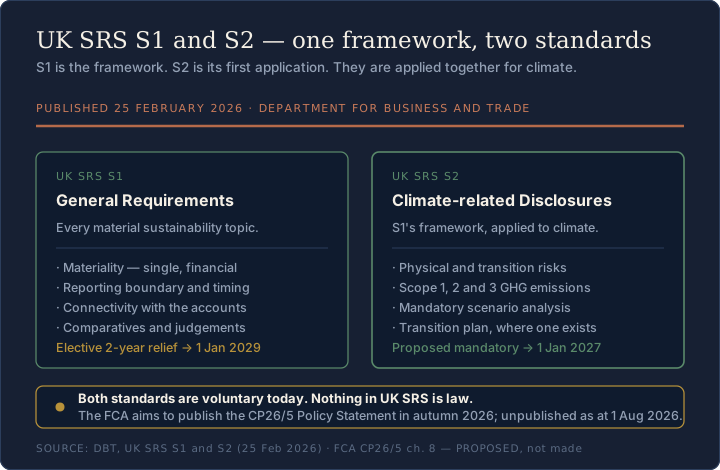
UK SRS S1 sets the general requirements for disclosing sustainability-related financial information: the materiality framework, the “Connected information” requirement and the disclosure architecture.
UK SRS S2 applies that framework to climate-related risks and opportunities: climate-specific requirements, greenhouse gas emissions, scenario analysis and transition plans.
Both are voluntary standards, applied together for climate-related matters; the FCA’s rules apply them to listed companies on a comply-or-explain basis.
The paired reading of UK SRS S1 and S2 — which requirement sits in which standard — is covered in full on our primary reference site.
Status
Voluntary standards, comply or explain for listed issuers
UK SRS S1 and S2 are voluntary standards, and no UK entity outside the listed categories is required to use them.
The FCA’s final rules (PS26/19, 30 September 2026) require listed companies in scope to report against both on a comply-or-explain basis for accounting periods beginning on or after 1 January 2027, with first reporting in 2028.
FCA CP26/5 had proposed mandatory S2 climate disclosures, excluding Scope 3; the final rules adopt comply or explain across all categories of disclosure instead.
The Policy Statement gives no total count; CP26/5 estimated that around 600 listed companies would be affected.
UK-specific differences, set out in Annex A of the government’s response, distinguish UK SRS from IFRS S1 and S2.
Why two standards
Why S1 and S2 came together
The relationship is fundamental: S1 is the framework, S2 is its first application.
S1 establishes the general requirements for materiality assessment, reporting boundaries and disclosure principles that apply to every sustainability topic.
S2 then applies those principles specifically to climate-related risks and opportunities.
The two-standard approach lets an entity start with climate — using the climate-first relief in UK SRS S1 ¶E3 — while building capability for broader sustainability reporting under S1.
Any future topic-specific ISSB standard would follow the same pattern, applying S1’s framework to a theme, but each would need its own UK endorsement before becoming part of UK SRS.
Evolution path
- 2017TCFD recommendations
The four-pillar climate reporting framework.
- 2021ISSB formed at COP26
To create global baseline standards.
- Jun 2023IFRS S1 and S2 issued
- 25 Feb 2026UK SRS S1 and S2
The UK endorses IFRS S1 and S2, with amendments.
Structure
How UK SRS S1 and S2 are structured
Both standards follow the four-pillar architecture inherited from TCFD.
| Pillar | UK SRS S1 | UK SRS S2 |
|---|---|---|
| Governance | Oversight of sustainability-related risks and opportunities | Climate-specific governance arrangements |
| Strategy | Impact on business model and value chain | Climate risks and opportunities in strategy |
| Risk management | Process for identifying and assessing sustainability risks | Climate risk management integration |
| Metrics and targets | Performance measurement and progress monitoring | Climate metrics, including GHG emissions |
Each pillar requires disclosure of current state and forward-looking information, with quantitative metrics where possible and qualitative explanation where quantification is not yet feasible.
The pillars in depth are at the four pillars of UK SRS.
Inside each standard
S1, the general requirements; S2, the climate disclosures
The foundational framework
Core requirements
- Materiality: investor-focused — risks and opportunities that could reasonably be expected to affect cash flows, access to finance or cost of capital (UK SRS S1 ¶¶3, 18).
- Reporting boundary: consistent with the financial reporting boundary.
- Timing: annual, aligned with the annual report.
- Connected information: clear links between sustainability and financial information.
Key features
- A building-blocks approach for topic-specific standards.
- Proportionality built in: reasonable and supportable information available at the reporting date without undue cost or effort. Comply-or-explain is the FCA’s listing rule, not a feature of the Standard.
- Forward-looking information is required; where UK SRS disclosures sit in the Strategic Report, DBT has confirmed the Companies Act 2006 section 463 safe harbour applies.
- Materiality inherited unchanged from IFRS S1 — the UK made no change to the test.
The framework applied to climate
Climate-specific requirements
- Physical risks: acute and chronic.
- Transition risks: technology, market, policy, legal, reputation.
- Opportunities: resource efficiency, energy source, markets, resilience.
- GHG emissions: Scope 1, 2 and 3, measured under the GHG Protocol Corporate Standard unless a jurisdictional authority requires another method, with transitional reliefs in Appendix C.
Transitional reliefs
- Scope 3: ¶C4 carries no time limit; under the FCA’s final rules a listed company may use one year’s non-disclosure, stating that it is doing so, then discloses or explains.
- Comparatives: first-year implementation relief.
- Climate only: optional non-disclosure of S1 non-climate matters, untimed in the Standard — the FCA’s final rules allow two years.
In practice
How UK SRS S1 and S2 work together
- Start with S2. Most entities will begin with climate disclosures.
- Use the S1 framework. Apply S1’s materiality and disclosure principles to them.
- Build capability. Develop systems for broader sustainability topics.
- Expand scope. Add non-climate topics under the S1 framework.
Reporting sequence under the FCA’s final rules
- 1 Jan 2027S1 and S2, comply or explain
Accounting periods beginning on or after this date; first reports in 2028.
- Year 1Scope 3 relief
One year’s non-disclosure, stated as used.
- Years 1–2S1 non-climate relief
Two years’ non-disclosure, stated as used.
- FutureFurther topic standards
Would follow the S1 framework — each needing UK endorsement.
FCA PS26/19 ¶¶3.12, 3.14, 3.20 — final rules, 30 September 2026
Differences
How UK SRS S1 and S2 differ from IFRS S1 and S2
The UK government consulted on six proposed amendments to IFRS S1 and S2 in June 2025, but two did not survive to publication and further provisions were added afterwards.
The authoritative list is Annex A of the government’s consultation response, which carries no headline count.
| # | Difference | What changed |
|---|---|---|
| 01 | No fixed effective date | Removed from the standards; required application is set by the FCA or under the Companies Act — the FCA has now set it, on a comply-or-explain basis. |
| 02 | Delayed reporting relief removed | Sustainability disclosures are published at the same time as the financial statements. |
| 03 | Climate-first relief made untimed | The Standard removes the fixed period entirely rather than extending IFRS S1’s one year; the FCA’s final rules separately allow it for two years. |
| 04 | SASB reference softened | “May refer to and consider” rather than “shall refer to and consider”. |
| 05 | Not a UK amendment: industry classification | The ISSB’s own December 2025 change to IFRS S2 permits any internationally recognised classification for financed emissions; the UK’s own proposal to drop GICS was withdrawn once the ISSB acted. |
| 06 | Transitional reliefs tied to required use | Added paragraphs clarify how an entity states compliance when using the reliefs, with application subject to the relevant UK regulation or legislation. |
IFRS baseline: IFRS Sustainability Standards navigator. Paragraph-level comparison: UK SRS vs IFRS S1 and S2.
Scope
Who S1 and S2 apply to, and from when
S1 and S2: comply or explain for listed companies in scope from accounting periods beginning 1 January 2027, with first reporting in 2028.
Scope 3: a one-year relief, during which a company states only that it is using it; then disclose or explain.
S1, broader sustainability: a two-year relief for non-climate matters, on the same terms; the Standard itself leaves the relief untimed.
Voluntary adoption: available to any UK entity from the publication date.
The full scoping test is at who must comply with UK SRS, and every date is on the UK SRS timeline.
| UKLR category | Under the FCA’s final rules |
|---|---|
| UKLR 6 — commercial companies | UK SRS, comply or explain |
| UKLR 16 — non-equity and non-voting equity shares | UK SRS, comply or explain |
| UKLR 22 — transition category | UK SRS, comply or explain |
| UKLR 14 — secondary listings | UK SRS, comply or explain (CP26/5 had proposed a statement only) |
| UKLR 15 — depositary receipts | UK SRS, comply or explain (CP26/5 had proposed a statement only) |
Existing regimes
How UK SRS interacts with existing UK regimes
Stays separate
- SECR remains a separate statutory regime; nothing in UK SRS S2 discharges it.
- The same emissions data will feed both, but they have different scope tests, boundaries and locations in the annual report.
- DESNZ has said it will consider how UK SRS emissions data interacts with SECR, with a view to reducing unnecessary duplication where possible — no change has been made.
From TCFD to UK SRS
- CP26/5 ¶4.4 proposed to delete the FCA’s TCFD-aligned rules and replace them with UK SRS S2 for in-scope issuers; the final rules put listed companies on comply or explain against UK SRS from 2027.
- The four-pillar structure is kept, with enhanced requirements.
- The final rules’ reliefs allow gradual adoption of Scope 3 and non-climate matters.
No duplication
- DBT has confirmed UK SRS S2 is a national reporting framework for section 414CB(6), so a company reporting under it need not duplicate its section 414CB(2A) climate disclosures.
- The Standard’s “Connected information” requirement strengthens links between financial and sustainability information.
- Board oversight requirements align with corporate governance.
Preparation
Preparing to report
- Materiality assessment: identify climate risks and opportunities.
- Data systems: establish GHG emissions measurement capability.
- Governance: set up board and management oversight structures.
- Legal review: understand the disclosure obligations and safe harbours.
- Assurance planning: decide whether to obtain assurance.
Compliance statement rules and common pitfalls are covered in the UK SRS reporting guidance.
The FCA’s final rules do not require assurance; where it is obtained, the company names the provider, the disclosures assured and the standards used.
ISSA (UK) 5000 is for voluntary use.
Frequently asked
UK SRS S1 and S2 — frequently asked
What are UK SRS S1 and S2?
UK SRS S1 (General Requirements for Disclosure of Sustainability-related Financial Information) and UK SRS S2 (Climate-related Disclosures) are the UK Sustainability Reporting Standards, published by the Department for Business and Trade on 25 February 2026 and available for voluntary use immediately. They are the UK's endorsed versions of the ISSB's IFRS S1 and IFRS S2, with UK-specific differences from the global baseline, set out in Annex A of the government's consultation response.
What is the difference between UK SRS S1 and UK SRS S2?
UK SRS S1 sets the general requirements for disclosing sustainability-related financial information — materiality, reporting boundary and the Connected information requirement with the financial statements — and applies to every material sustainability topic. UK SRS S2 applies that framework to climate specifically, covering climate-related risks and opportunities, greenhouse gas emissions, scenario analysis and transition plan disclosure. S1 is the framework; S2 is its first application, and the two are applied together for climate-related matters.
When do UK SRS S1 and S2 apply?
Both have been available for voluntary use since 25 February 2026. Under the FCA's final rules (PS26/19, 30 September 2026), listed companies in scope report against UK SRS S1 and S2 on a comply-or-explain basis for accounting periods beginning on or after 1 January 2027, with first reporting in 2028. A company may use one year's non-disclosure of Scope 3 under S2 and two years' non-disclosure of S1 non-climate matters, stating that it is doing so. The Standards' own reliefs carry no fixed period; the FCA's rules set those lengths.
Are UK SRS S1 and S2 mandatory?
No. UK SRS S1 and S2 are voluntary standards. The FCA's final rules (PS26/19, 30 September 2026) require listed companies in scope to report against them on a comply-or-explain basis — report, or explain why not — for accounting periods beginning on or after 1 January 2027. CP26/5, the consultation, had proposed making S2 mandatory; the final rules do not. For every other UK entity the standards remain voluntary.
How do UK SRS S1 and S2 differ from IFRS S1 and S2?
UK SRS is based on the ISSB's IFRS S1 and IFRS S2. The UK government consulted on six proposed amendments in June 2025, but two did not survive to publication; the authoritative list of final differences is Annex A of the government's consultation response, which carries no headline count. The most significant: the effective-date clauses were removed; the IFRS S1 relief allowing sustainability information to be published at a different time from the financial statements was withdrawn; the relief permitting non-climate topics to be deferred was retained but left untimed in the Standard itself (the FCA's final rules allow it for two years); SASB references were softened from 'shall refer to and consider' to 'may refer to and consider'; added paragraphs clarify how an entity states compliance when using the reliefs. The Global Industry Classification Standard requirement was dropped by the ISSB's own December 2025 change to IFRS S2, not a UK amendment.
Do UK SRS S1 and S2 replace SECR?
No. DESNZ published the statutory post-implementation review of SECR on 26 May 2026 and its formal recommendation is to retain the SECR requirements with amendments, noting that removing SECR would risk reversing gains in transparency and board-level accountability. On the interaction with UK SRS the government has committed only to consider how energy and emissions data reported under UK SRS interacts with SECR, with a view to reducing unnecessary duplication where possible.
Sources
Primary sources
Every figure, date and status on this page traces to the instrument’s owner. Secondary commentary is never the source for a number.
- Department for Business and TradeUK SRS S1 and UK SRS S2 — publication page
The final standards, published 25 February 2026.
- Department for Business and TradeUK SRS S1 General Requirements — final standard (PDF)
Materiality (¶¶3, 18), Connected information, the climate-first relief (¶E3).
- Department for Business and TradeUK SRS S2 Climate-related Disclosures — final standard (PDF)
Scope 1–3 emissions, scenario analysis, transitional reliefs in Appendix C.
- Department for Business and TradeExposure drafts of UK SRS — consultation response (PDF)
Explains the UK-specific amendments made to IFRS S1 and S2 (Annex A).
- Department for Business and TradeGovernment response to the UK SRS consultation — web version
Chapter 3: the DESNZ commitment on SECR duplication, s.414CB(6) and s.463.
- Department for Business and TradeUK Sustainability Reporting Standards — guidance
Voluntary use open to any UK entity from publication.
- Financial Conduct AuthorityPS26/19: Aligning listed issuers' sustainability disclosures with international standards
First published 30 September 2026. The final rules: comply or explain across the UK SRS (¶1.2, ¶1.7), UKLR 6, 14, 15, 16 and 22 (¶3.6), from accounting periods starting on or after 1 January 2027 (¶3.12), reliefs (¶3.14).
- Financial Conduct AuthorityCP26/5: sustainability disclosures — consultation page
The FCA consultation on listed-issuer implementation that PS26/19 finalises.
- Financial Conduct AuthorityCP26/5 — full text (PDF)
The consultation: ¶¶1.5–1.6 (the mandatory S2 it proposed), ¶¶4.4 and 4.8, and Annex 2 ¶43 (its estimate of around 600 affected).
- IFRS FoundationIFRS Sustainability Standards navigator — IFRS S1 and S2
The international baseline UK SRS is based on.
- IFRS FoundationIFRS S1 — full text
Current-state and forward-looking disclosure across the four pillars.
Continue reading
Read next
What is UK SRS?
Introduction to the UK Sustainability Reporting Standards: the concept and current status.
UK SRS S1
The general requirements standard in detail.
UK SRS S2
The climate standard in detail.
UK SRS Timeline
Key dates and implementation phases for UK SRS.
UK SRS Reporting Guidance
Practical guidance on preparing UK SRS disclosures.